He Sold Phones to Nobody. Then He Changed One Word and Sold Out.
A fictional lawyer in a tracksuit just taught the clearest positioning lesson of the decade. The product never changed. One word did. And it is the same move that decides whether your business gets chosen or ignored.
There is a scene in Better Call Saul that should be required viewing for every business owner. Not because of the writing, although it is some of the best on television. Because in about four minutes, it quietly explains why some businesses get chosen and most get ignored.
It is too good to leave buried in a streaming binge. So here it is, broken down, with the part that actually matters for your business.
The Dead Store Every Owner Knows
Saul, before he is Saul, takes a job selling cell phones at a forgettable store called CC Mobile. The store is dead. He is vacuuming an empty floor. He calls his boss and asks, basically, "Is it always this slow?"
It is.
Every business owner knows this feeling. The quiet phone. The empty calendar. The website that gets visitors who never convert. You did the work. You opened the doors. And the market just... shrugged.
Most people respond by working harder inside the same broken setup. More hours. More discounts. A louder version of the same message nobody was responding to in the first place.
Saul did something else.
The One Word That Changed Everything
He did not change the product. The phones stayed exactly the same. He changed who he was selling to and what problem the product solved.
He painted a sign in the window. It did not say "Cell phones for sale." It did not list data plans, roaming, or hands-free calling. It said:
"Is the man listening? Privacy sold here."
Same phone. Different word. He stopped selling technology and started selling privacy. And suddenly a product nobody wanted became a product certain people needed badly enough to pay cash for, no questions asked.
This is what the business writer Peter Drucker meant when he said the job of a business is to create the customer. You do not always need a new product. Sometimes you need to take the product you already have and aim it at a different problem, felt by a different person, described with a different word.
Saul did three more things worth stealing:
- He made the problem feel urgent before he offered the fix. "They are always listening." Fear first, solution second.
- He named the solution. He called it "information hygiene." A clever name makes a vague worry feel solvable, and makes you the one who solves it.
- He looked like his customers. In a suit he got called a narc. In a tracksuit he became one of them and sold out his inventory. Packaging is part of the message.
None of that required a better phone. It required a better position.
The Reposition Test (Steal This)
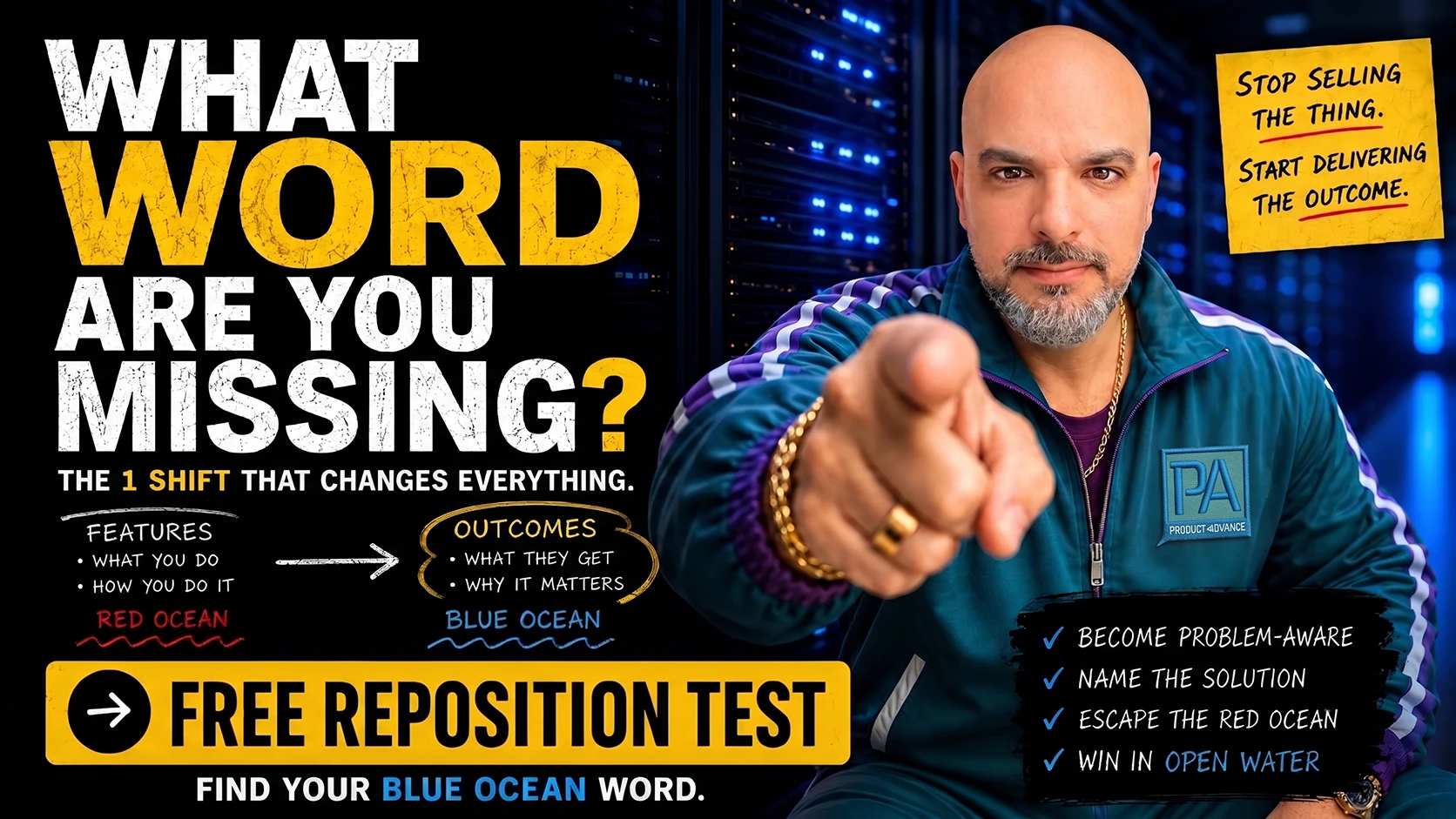
You do not need a screenwriter to do this. You need to answer five honest questions. We call it the Reposition Test, and you can run it on your own business in the next ten minutes.
What are you really selling?
Not the product. The outcome. He sold privacy, not phones. A gym sells confidence, not equipment. What is your "privacy"?
Who feels that need most?
Stop selling to everyone. Find the person whose problem is sharpest, most urgent, most expensive to ignore.
What do you call it?
Name the problem and the solution. "Information hygiene." A name makes it real, repeatable, and yours.
Do you look like the buyer?
Your website, your words, your visuals. If you look like an outsider, you get treated like one. Match the room.
Are you where they are?
He stopped waiting in a dead store and brought the product to the customers. Go to where attention already lives.
Is the water crowded?
If everyone in your category says the same thing, you are in a red ocean. The fix is to move, not to shout.
Red Ocean vs Blue Ocean
That last question is the whole game. Strategists call it red ocean versus blue ocean. A red ocean is crowded water where everyone competes on the same terms, so the only lever left is price and the only outcome is shrinking margins. A blue ocean is open water you create by repositioning around a different problem, where the competition barely follows.
Positioning, in one sentence, is the space you occupy in the customer's mind relative to your competitors. Here is what each ocean looks like in practice.
- You sell the product (a phone, a haircut, a website)
- You sound like every competitor in your category
- Buyers compare you on price because nothing else stands out
- You chase customers who are hard to convince
- Margins shrink every year
- You are one option among many
- You sell the outcome (privacy, confidence, time, peace of mind)
- You own a word your competitors are not using
- Buyers come pre-sold because you named their exact problem
- You attract customers who feel understood
- Price stops being the conversation
- You are the obvious choice
Notice that nothing in the blue column required a new product. It required a new position. The boat moved. The ocean changed.
Why This Is Really About Your Website
Here is the uncomfortable part, and the reason we care about this so much.
Buying a website is one of the reddest oceans on the internet. There are Wix, Squarespace, and a hundred AI builders all selling the same thing with the same words: drag, drop, launch, cheap. Every option looks interchangeable, so people shop on price, and they end up with a site that looks finished from ten feet away and quietly fails the moment a real customer tries to trust it.
The businesses that win do not buy a website at all. They buy the outcome: a real team that designs it, launches it, hosts it, and supports it, so they never touch a builder and never wonder who to call when something breaks.
That is the same move Saul made. Stop selling the phone. Sell the privacy. Stop buying a website. Buy a team that handles it for you, in the USA, the way we have since 2009. Affordable, custom, and yours, starting around the price of a couple of streaming subscriptions a month.
We are not in the website business. We are in the "you never have to think about this again" business.
That is our blue ocean. And the reason we can spot yours is that we had to find our own first.
Tell us what you sell. We'll send back the one sentence that repositions it.
Run the Reposition Test yourself, or let us run it for you. Send us your business and your site, and a real strategist on our US-based team will reply with a custom teardown, no pitch, no obligation.
- The one-sentence repositioning of your offer (your "privacy sold here")
- Two or three blue-ocean angles to test, specific to your business
- The single word your competitors are not saying that you could own
Frequently Asked Questions
What is positioning, in plain English?
Positioning is the space you occupy in the mind of a customer relative to your competitors. It is not your logo, your colors, or your feature list. It is the single idea a buyer reaches for when they think about the problem you solve. Strong positioning makes you the obvious choice; weak positioning makes you one of many.
How do I reposition my business without changing what I sell?
Keep the product the same and change the problem it solves and the person who feels that problem most. The cell phone did not change, the message did: from technology to privacy. Ask what your customer is actually buying, who feels that need most urgently, and what to call the outcome so it feels solvable. Our free Positioning Teardown does exactly this for you.
What is the difference between a red ocean and a blue ocean?
A red ocean is a crowded market where everyone competes on the same terms and price, so margins shrink and you blend in. A blue ocean is open water you create by repositioning around a different problem or buyer, where competition is far less direct. Moving from red to blue is usually a messaging and focus shift, not a new product.
How does this apply to my website?
Most businesses shop for a website by feature and price, which is the reddest ocean online. The winners do not buy a website at all, they buy an outcome: a real team that designs, launches, hosts, and supports it so they never touch a builder. That is the same move as selling privacy instead of phones, applied to your digital presence. See Product Advance for how we do it.
Can Product Advance help me find my positioning?
Yes. Our free Positioning Teardown reads what you sell and sends back the one sentence that repositions it, plus two or three blue-ocean angles to test. It is a fast, no-pressure way to see your business through a sharper lens. Request one and a real person on our US-based team will reply.
Pick the Next Step That Fits Where You Are
Start with a free teardown, then move into real strategy when you are ready.
Get Your Free Positioning Teardown
The one sentence that repositions your offer, plus blue-ocean angles to test. Written by a human.
Start the teardown → Free · AI VisibilitySee How AI Describes You
AI search is now the customer's mind. Find out whether your positioning is landing or dissolving.
Run the check → Strategy · 30 minTalk to a Real Strategist
Done-for-you websites and positioning from a US-based team that has built since 2009. No fluff.
Book a call at Product Advance →